
Oakland SAVES Grant Program
Oakland Saves StoryMap
Energy efficiency supports all three pillars of sustainability—environmental, social, and economic—by reducing greenhouse gas emissions, lowering energy costs, and creating local jobs. In celebration of Earth Day, Oakland County is showcasing the impact of its 2024 energy efficiency program, Oakland SAVES, which provided upgrades that benefitted both the environment and the community through a brand-new StoryMap.
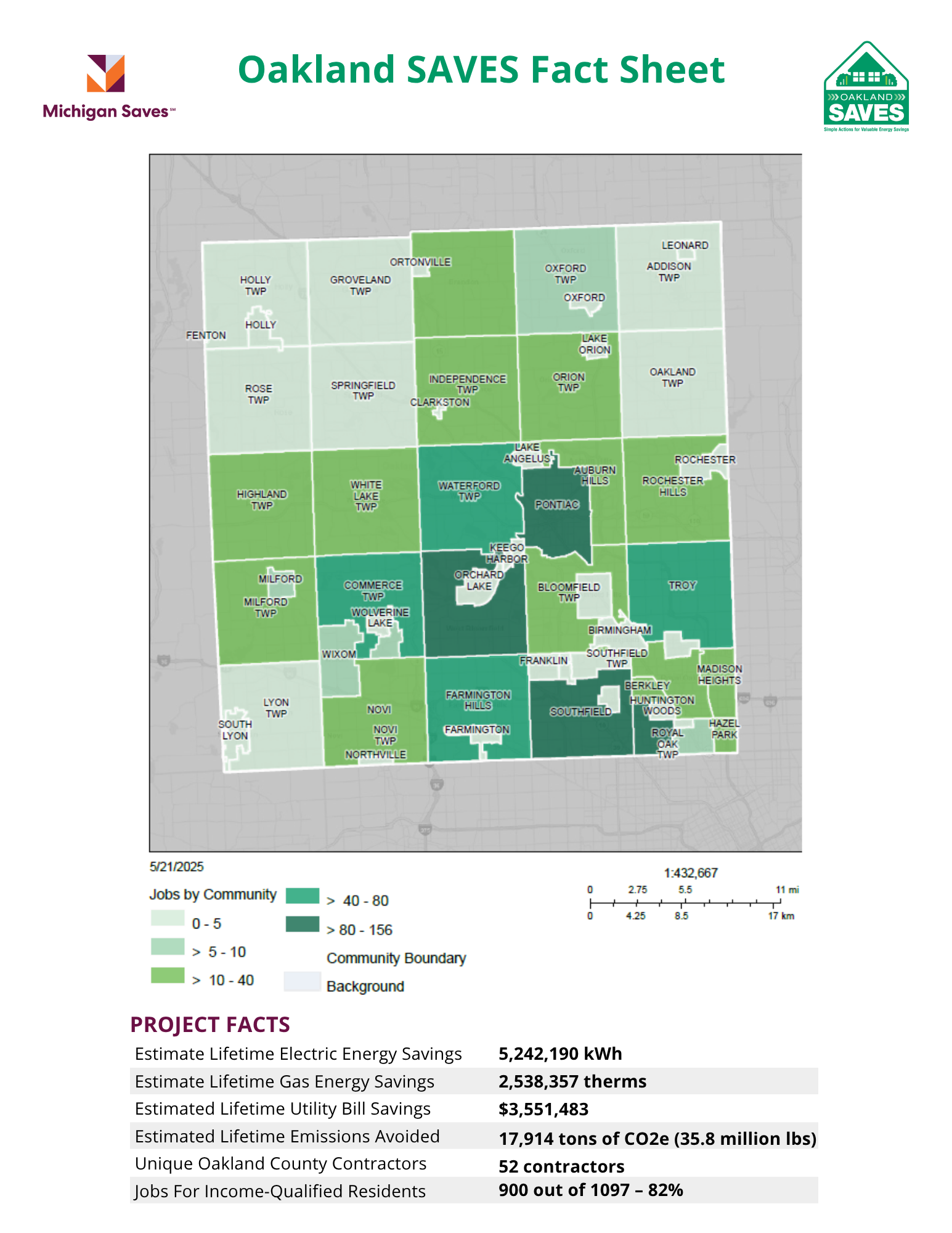
Oakland County partnered with Michigan Saves to upgrade nearly 1,100 households, improving comfort, resilience, and reducing utility bills, while also generating over $7.7 million in local contracting work. The StoryMap features participant testimonials, a map of completed projects, and an analysis of its environmental, social, and economic impacts.
Visit the new Oakland Saves StoryMap
Application Closed
The response to the Oakland SAVES program was phenomenal with more than 1,100 households receiving approval for the money saving, energy efficiency upgrade grants in less than a week. Tier 1 and Tier 2 grant incentive funds have been fully committed to previous applicants. The application is no longer available.

THERE ARE STILL OPTIONS
- Michigan Saves has a residential financing program that provides low-interest loans to homeowners for eligible energy-efficiency projects.
- Oakland County’s Neighborhood and Housing Development department has a home improvement program that provides interest-free low loans for needed house repairs.
- OLHSA has a weatherization assistance program that is a free energy conservation service for low-income households to reduce energy usage and utility bills.
- DTE Energy Efficiency Assistance
- Consumers Helping Neighbors Program
- Oakland County is actively seeking partners to help extend and expand the Oakland Saves initiative.
Oakland County partnered with Michigan Saves, the nation’s first nonprofit green bank, to invest $5 million in American Rescue Plan Act funding to provide qualified residents with an Oakland SAVES grant. These grants were used for energy efficient upgrades to homes, producing savings in energy consumption and utility bills and improving our residents’ health, safety and comfort.
“Helping our residents upgrade the energy efficiency of their homes will not only enable them to save money on their utility bills but will also be beneficial for the environment. Less energy usage means a reduction in carbon emissions and that translates into a cleaner, more sustainable environment for all of us.”
Dave Coulter, County Executive
Any qualified resident in Oakland County applied for a grant in one of two tiers:
- Income-qualified households received up to $5,000 from a pot of $4 million to help pay for projects.
- Other residents applied to have 20% of a sustainable home improvement project covered by a grant, capping out at $3,000 each from a pot of $1 million.
Eligible improvements included: the installation of insulation, energy-efficient doors and windows, weatherstripping, and heating, ventilation, water heater and air conditioning improvements.
For more ways to improve your energy efficiency and reduce both costs and climate impact at home, check out the resources on our Sustainability at Home page.
News & Updates
Contact Info
Sustainability
Coulter Appoints Julie Lyons Bricker Chief Sustainability Officer as County Earns Gold from Michigan Green Communities Program
2 Jul, 01:05 PM
Julie Lyons Bricker brings more than two decades of sustainability leadership, project management and public service experience to her new role.
- Oakland County Executive Dave Coulter has appointed Julie Lyons Bricker as chief sustainability officer to help lead the county toward net zero greenhouse gas emissions by 2050.
- Lyons Bricker brings more than two decades of sustainability leadership, project management and public service experience to her new role.
- Under her leadership as sustainability project manager, Oakland County was recently awarded Gold Certification by the Michigan Green Communities (MGC) program.
 Pontiac, Mich. – Oakland County Executive Dave Coulter has appointed Julie Lyons Bricker as the chief sustainability officer who will move the county toward its bold vision to achieve net zero greenhouse gas emissions by 2050.
Lyons Bricker brings more than two decades of experience in sustainability leadership, project management and public service to her new role. Her career spans both public and nonprofit sectors, previously serving as Oakland County’s sustainability project manager. She also held dual roles in the City of Royal Oak as energy and sustainability manager and executive director of the Royal Oak Civic Foundation.
“Julie is the right leader to guide us forward as we build a more sustainable and resilient future,” Coulter said. “Her leadership will help us accelerate our sustainability goals in meaningful ways that benefit the county government, our communities and future generations.”
Lyons Bricker’s qualifications are underscored by her professional credentials and education. She holds a Bachelor of Science in Forestry from Michigan Technological University and has completed the Executive Education for Sustainability Leadership program at Harvard T.H. Chan School of Public Health. She is also a certified Project Management Professional (PMP) and LEED AP in Operations and Maintenance.
“I'm delighted Oakland County Executive Dave Coulter has appointed me to be the county’s next chief sustainability officer,” she said. “I look forward to leading our internal and external sustainability and resiliency efforts and the many opportunities we have to make a substantial difference in the region.”
Under Lyons Bricker’s leadership, in her previous role as the county’s sustainability project manager, Oakland County was awarded Gold Certification by the Michigan Green Communities (MGC) program for its leadership in environmental sustainability, climate resilience and community engagement. The recognition was announced as part of the 2024 Michigan Green Communities Challenge, which saw a record number of local governments across the state participate.
Oakland County earned gold status for significant progress across several categories including resource protection, green buildings, hazard mitigation, flooding and stormwater mitigation, energy efficiency improvements and environmental stewardship. Notable achievements include the implementation of countywide green infrastructure practices, continued investment in energy efficiency upgrades at county facilities, expansion of electric vehicle charging infrastructure, programming for Oakland County homeowners to make energy efficiency improvements to their properties and robust community engagement through programs.
Oakland County joins 42 Michigan communities that earned gold certification in the 2024 MGC Challenge. The program recognized a total of 68 local governments, with six achieving bronze status, 18 earning silver and two communities reaching platinum. Oakland County is working hard to benchmark and track sustainability data with the goal of reaching platinum status within the next two years.
The Michigan Green Communities program is a free statewide initiative that supports local governments in making measurable progress toward sustainability goals. Backed by a coalition of state agencies and local government associations, MGC helps communities strengthen their infrastructure, improve public health, reduce environmental impact, and enhance economic competitiveness.
For more information about Oakland County’s environmental initiatives, visit oakgov.com/sustainability.