
Oakland County Fiscal Scorecard
DAVID COULTER, OAKLAND COUNTY EXECUTIVE
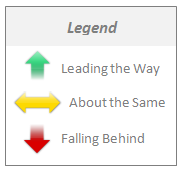
To help Oakland County residents assess the financial management of Oakland County government, we present the following "Oakland County Fiscal Scorecard." We also encourage readers of the scorecard to also take advantage of the wealth of financial information that we have made available to the general public through our Investor Relations web page.
 Is Oakland County covering current year expenditures and other obligations with current year revenues?
Yes. In September 2021, Oakland County adopted a balanced 3-year rolling budget for Fiscal Years 2022, 2023 and 2024. For FY 2022 only, the budget utilizes the current year revenues and a planned-for, nominal amount of accumulated equity that already exists in excess of the levels needed to maintain a reserve of at least 30% of operating expenditures. For future years the County is aligning on-going expenditures with on-going revenues. In the interim, however, the General Fund equity is well in excess of the 30% long-range target. The available equity comes from savings that have accumulated over the past several years as a result of the continued long-term financial focus. The FY 2022 – FY 2024 budget reflects general favorability / turnover factors directly into the line-item budget to account for the historical favorability trends that have occurred over the years. The use of fund balance that is available over the 30% equity target will be limited to items that promote one-time investments that advance the initiatives and priorities of Oakland County.
In addition, Oakland County's budget recognizes and has fully funded its pension, health care and other post-employment benefit (i.e. "retiree's healthcare") obligations.
In short, the County has maintained a balanced budget throughout the Great Recession, fully-funded its pension and health care obligations within our balanced budgets. The County's long-term outlook includes assumptions for the Headlee rollback calculation and the limitations for property tax revenue over the next five years. The property tax assumptions are monitored and updated as needed as part of the County's on-going fiscal sustainability efforts. The County's balanced budget principles, in addition to its solid tax base and strong financial policies, have enabled the County to retain its 'AAA' bond rating by two bond rating agencies every year since 1998.
Is Oakland County paying current bills with cash on-hand?
Yes, Oakland County maintains responsible cash balance reserves and pays its bills on time using its cash on-hand. Starting in 2004, all Michigan counties are now required to collect taxes in arrears. This means that taxes used to pay for current year expenses are not billed until 9 months into the fiscal year and are not due until 11 months into that year. (Think of not being paid at your job until after you have worked for 11 months and incurred mortgage, food and other expenses.) Effectively, this means county governments have to operate for 335 days before they receive the tax revenue to support those operations. This shift in tax collection period caused a cash-flow shortage that requires many county governments in Michigan to rely on short-term borrowing to ensure bills are paid on time. To date, Oakland County has not been required to borrow to cover the County's operating expenses.
Does Oakland County have reserves or a Rainy Day Fund equal to at least 10% of operating expenditures?
Yes, Oakland County maintains responsible reserves well-above 10% of operating expenditures to protect and maintain stable service delivery. At the September 30, 2020 fiscal year close and reported in the FY 2020 Comprehensive Annual Financial Report, Oakland County's General Fund had unrestricted (meaning available) equity (fund balances) totaling $266.5 million. This amount is over the County's targeted minimum fund balance level of 30% of annual expenditures.
Is Oakland County paying current bills with cash on-hand?
Yes, Oakland County fully funds its pension and other post-employment (retirees' healthcare) benefit obligations. These expenses are included in our annual operating budgets and are not pushed off onto future generations.
Oakland County closed the traditional defined benefit retirement plan to new hires in 1994, replacing it with a fair, but far less costly, defined contribution plan. The defined contribution plan benefit is fully funded on an annual basis. In 1997 new hires began mandatory contributions to their healthcare coverage. By 2003 all employees were paying mandatory contributions to their healthcare coverage.
Similarly, in 2006 Oakland County replaced the traditional retiree health care benefit and replaced that with a Health Care Saving Account, for employees hired after January 1, 2006. The Health Care Savings Account is a benefit that gradually vests over an employee's career. This benefit plan is also fully funded for each member employee on an annual basis.
In 2007, Oakland County became the first Michigan governmental unit to fully fund the traditional retiree health care benefit obligations incurred before adoption of the Health Care Savings Account Program. Oakland County started actuarially funding its retiree health care obligation in 1987. In 2007, the County issued "Certificates of Participation" (COP's), a type of bond, and established a source that fully-funded its existing retiree health care obligation for current and future retirees. On September 27, 2013 Oakland County initiated a private placement of securities to refinance the 2007 COP's thereby reducing annual interest payment rates from 6.23% to 3.62%, a net savings of approximately $171 million. This refinancing not only saved the County taxpayers money, it also included the development of a superseding plan to secure health care for all eligible County retirees and their covered dependents to the end of their eligibility. Upon completion of the refinancing, the VEBA fund assets were 117% of the fund actuarially determined liabilities. The COP's debt was paid off on April 1, 2014. The defined benefit pension plan based on the actuarial value of assets (funding value) as of period ending September 30, 2020 indicates that the County is 102.2% funded. The retiree health care plan based on the actuarial value of assets as of period ending September 30, 2020 reflects that the County is 150% funded for the retiree health care plan.
The annual cost of retiree pension and health care benefits, both for the current year's expenses and the actuarially determined amount for the future years' costs, are accounted for in each year's operating budget. None of the costs are hidden and none are pushed off onto future generations.
Are incomes growing faster than public debt levels?
Oakland County government's per capita public debt level in 2020 was estimated at $280.46. This includes general obligation debt, backed by the full faith and credit of the taxpayers, and revenue-dedicated debt that is repaid through specific revenue associated with the projects that it funds. The debt was incurred primarily to support water, drain and sewer projects, and also includes the Retiree Healthcare Refunding bonds discussed previously. The Per Capita Personal Income (PCPI) has risen from $53,123 in 2008 to the most recent published amount of $76,941 in 2020. Oakland County is ranked 1st in the state in PCPI. (Source: Department of Commerce, Bureau of Economic Analysis.)
It is important to understand that while some Michigan governments have borrowed and owe amounts close to their maximum constitutionally-authorized debt level, Oakland County is nowhere near to that situation. As reported in the FY 2020 Comprehensive Annual Financial Report, Oakland County is constitutionally authorized to incur approximately $8.1 billion in debt, yet its actual debt is only $633.2 million, about 7.8% of what is Constitutionally Authorized.