Our office, in partnership with many organizations, are working to create a statewide water affordability program. There is no federal or state plan set in place to provide a solution to the rising cost of water. By working with our communities and residents, we strive to effectively understand their needs and concerns. Click here to read our water affordability journey thus far.
Need assistance with your water bill? We can help!
There are two programs to assist you with water affordability. The Great Lakes Water Authority’s Water Residential Assistance Program (WRAP) and our Hardship Assistance Program. Both programs are administered by the United Way for Southeastern Michigan for residents in Oakland County.
WRAP provides funding to eligible, low-income households for up to two years and can help Oakland County residents reduce their water bills and pay past due balances.
The Hardship Assistance Program provides emergency relief funds and support to those experiencing hardship. This program has annual eligibility, can help cover water bills for up to three months and can help Oakland County residents recover from water debt. Both programs can provide funding for plumbing repair costs if eligible.
Call 844-211-4994, Monday through Friday, 9 a.m. to 4 p.m. and press 3 for water assistance or visit unitedwaysem.org/utility-assistance. The United Way for Southeastern Michigan Care Coordinators will assist you.
Water Affordability Legislation
In January of 2023, our office joined Senator Stephanie Chang’s workgroup with the shared goal of developing a statewide affordability plan with sustainable funding. The legislative package is the first step in addressing Michigan's water affordability challenges. Michigan could be the first state in the United States to implement a water affordability program. The water affordability bill package created the “Human Right to Water Act.” This act aims to allow the state government to work toward policies that help make water affordable for Michigan residents.
- Affordability plan: Families making up to 135% of the poverty level will pay about 2% of their income for water, while those making up to 200% will pay about 3%. This plan will help with plumbing fixes and forgiving past-due water bills.
- Affordability fund: The main source of funding will be a monthly, per meter, $2 addition to water bills.
- Shutoff Protection Act: This legislation safeguards households, especially those grappling with life-threatening illnesses or dependent on life support systems, as well as low-income families, against the discontinuation of their water supply. It creates a transparent communication procedure to guarantee that residents are properly informed prior to any potential water service interruptions. Additionally, the legislation extends protection to customers actively participating in a water affordability plan, those making minimum good faith payments, and prohibits the disconnection of water services for households in multi-unit dwellings due to lack of payment attributed to another household.
- Tenant submetering: This law allows renters to ask their landlord to transfer the water bill into their name within 60 days if their home has its own meter or sub-meter. Once completed, landlords can't include water or sewer charges in the rent. This change will only apply to new rental agreements.
- Decriminalization of water hook-ups: Reconnecting water service after a shut-off due to the inability to pay will no longer be a five-year felony. It would be a civil infraction with community service and a fine. This would not apply if a metering or backflow device was damaged during reconnection.
Click here to learn more about water affordability in Michigan.
Frequently Asked Questions
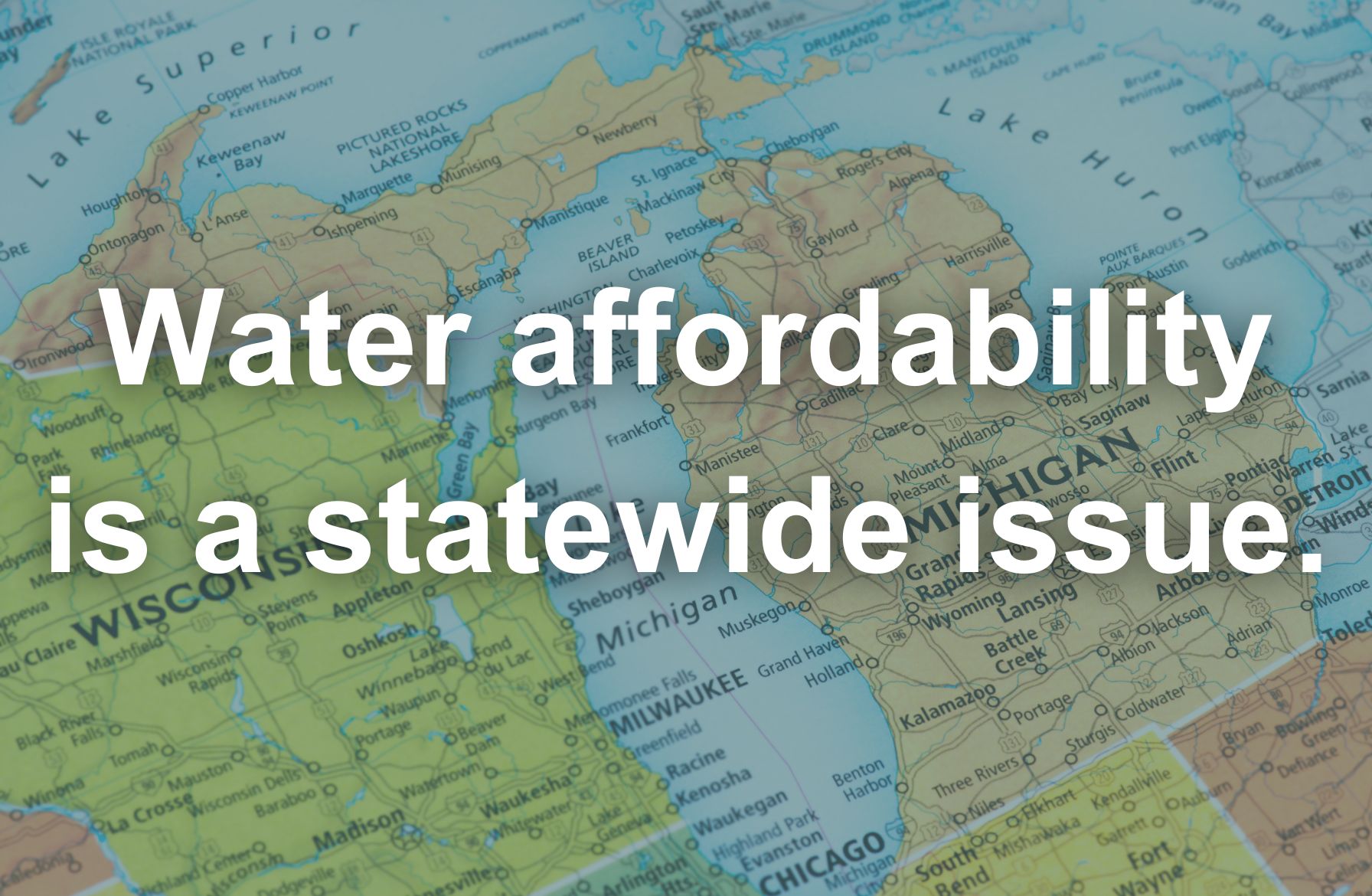
A recent statewide assessment found that low-income households across Michigan are struggling to pay their water bills, including the Southeast region, small towns in the Upper Peninsula, and on the west side of the state. Many water providers serving smaller populations don’t have the capacity to offer water affordability programs. In addition, water providers, especially those serving larger populations, cannot self-fund programs without significant financial burden to other ratepayers or jeopardizing revenues needed to properly invest in the water systems.
There are three major factors for these bills. First, it protects public health by ensuring proper sanitation through access to affordable drinking water and sanitary sewer services. Second, it provides revenue for water providers which reduces the need for rate increases to cover bad debt and stabilizes budgets that are vital to managing water infrastructure. Third, it gives low-income households across the state access to a program that will help eliminate water debt, avoid water service disconnection, repair plumbing leaks, and stay current on water bills.
No. Customers already cover the debt of other customers who cannot afford their water and do not pay their bills. Unpaid water bills may become a bad debt expense which is incorporated into rates the following year. The debt may eventually be collected through property taxes or foreclosure, but the delay in recovering the revenue may impair the fiscal stability of the utility and water system operations. That means, a water provider may have to defer maintenance or capital improvements that ultimately end up costing ratepayers. The fee will be paid directly to water providers to recover costs of service, not for general revenue raising.
When residents are unable to pay their water bill, it affects the operation of water systems and the maintenance of the infrastructure needed to provide reliable water services to all customers. The water affordability program will require low-income customers to pay an amount that is affordable based on their household income. The fee collected from all water customers will ensure that water providers can pay the “gap” between the amount of the affordable bill and the actual cost of service. This will help reduce the bad debt expense and utility collection costs which creates financial stability for water providers and improves their ability to properly invest in water system infrastructure.
Many programs already exist to help low-income households pay for essential needs like food, shelter, gas and electric bills, and medical care, but there is not a similar program for another essential need: water. The water affordability program and funding mechanism in these bills are modeled after the Michigan Energy Assistance Program (MEAP) that was established over a decade ago by the Synder administration with bipartisan legislation. MEAP helps low-income households pay for gas and electric utilities and a corresponding water affordability program could help pay for water utilities. Together, these resources help foster financial stability for low-income households.
The legislation is flexible so that the $2 fee and the program benefit can be adjusted based upon the amount of revenues collected and the number of eligible households that enroll. Reporting requirements and financial analysis are required so that proper projections can be made, and a task force can recommend adjustments.
The fact that WRAP was created acknowledges the long-standing need for water affordability programs. WRAP was designed as a temporary two-year assistance program, with finite funding, only assisting customers in the GLWA service area. This legislation will allow WRAP and other existing programs, like the City of Detroit’s Lifeline Plan, to become permanent programs with sustainable funding sources. In addition, a statewide program will be available to provide similar programs and benefits to customers residing in other municipalities. An affordable water bill should not be based on where you live. A statewide program will ensure all low-income households across the state have access to affordable water bills.
This legislation creates a groundbreaking program that hasn’t been done anywhere in the country. Low-income households will pay dramatically less for water services and, if they are still experiencing financial hardship, there are additional protections in the legislation to refer the customer for wraparound services and resources from other agencies. There is no silver bullet to eliminate poverty, but these bills provide significant protections to low-income households, and critical care customers. By utilizing existing administrative models, the program will be easy to apply for and manage with other benefit programs.
Water Affordability Solutions Report
In May of 2021, our office was awarded an Affordability and Planning Grant by the Michigan Department of Environment, Great Lakes, and Energy (EGLE) to accomplish many objectives related to water affordability while maintaining water quality and safety standards. The grant deliverables required we create customized water affordability plans to meet the needs of a larger community, the City of Pontiac, as well as a smaller community, the Charter Township of Royal Oak. After nearly 15 months of research, we are proud to release our report and findings to the public, which include a scalable water affordability framework designed to assist water systems of all sizes across the state.
Have a question related to water affordability? Email us at affordability@oakgov.com.