
Hon. David M. Cohen
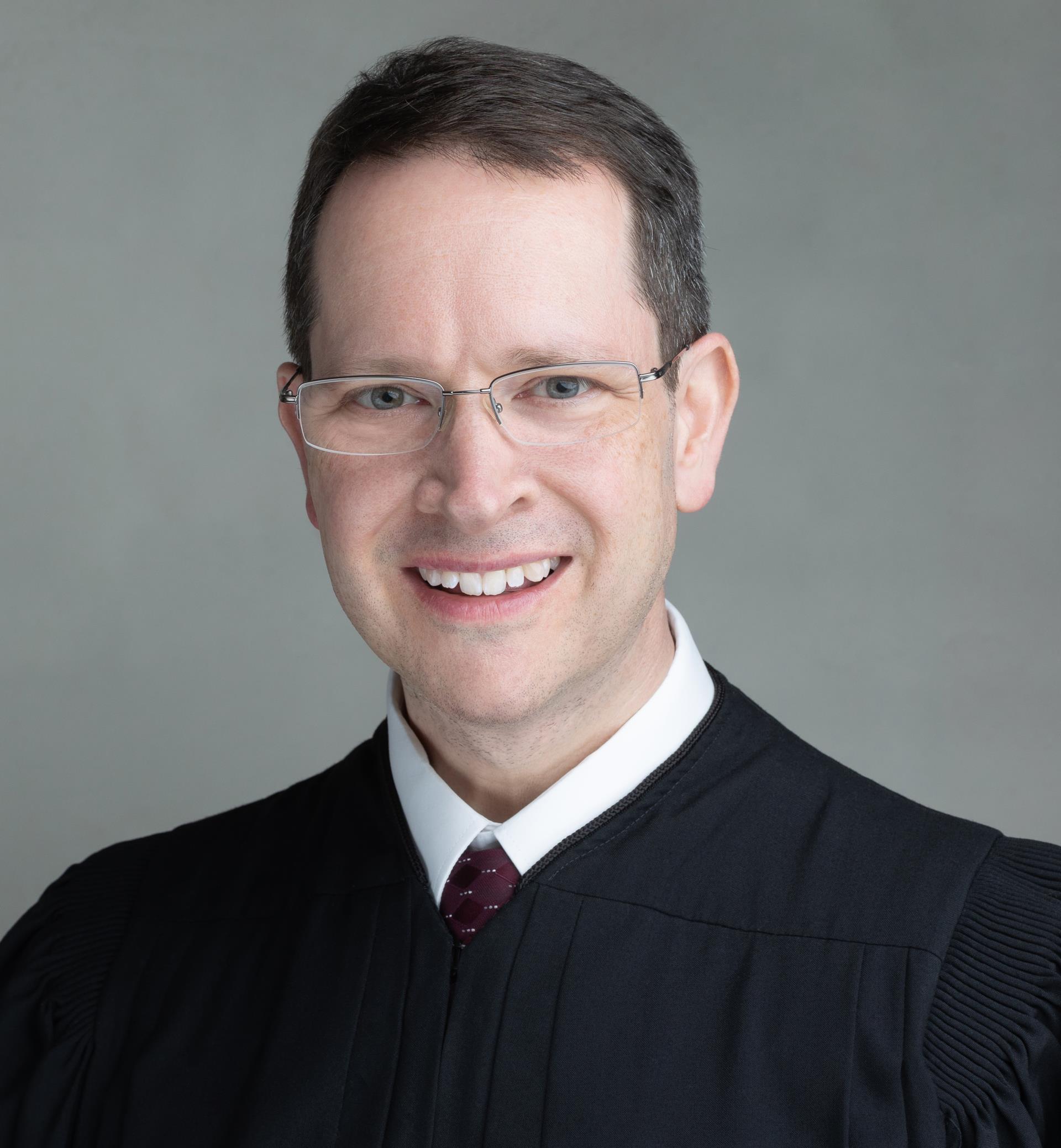
Honorable David M. Cohen was appointed to the Oakland County Circuit Court bench in February of 2022, re-elected in November of 2022, where he presides in the general civil and criminal division. Judge Cohen served as a managing administrative law judge with the Detroit office of the Michigan Office of Administrative Hearings and Rules, providing supervision to 21 administrative law judges in the areas of unemployment and MERC. Previously, Judge Cohen served as an administrative law judge in the field of general adjudication. Prior to his role as an administrative law judge, Judge Cohen practiced law in the areas of personal injury, ADA disability rights, and administrative legal matters. Judge Cohen served as an alternate hearing officer for the Michigan Attorney Discipline Board and as a member of the Michigan Bar Journal Publication Committee. Judge Cohen earned his Juris Doctor and Bachelor of Arts degrees from Wayne State University. Judge Cohen was the 2025 recipient of the Ruth Bader Ginsburg Champion of Justice Award from the Jewish Bar Association of Michigan.
Protocol
In order to better serve the attorneys and litigants appearing in Judge Cohen's courtroom, we have adopted the following guidelines. Please advise your clients and staff so that there are no misunderstandings. Obtain a copy of the Protocol.
Oakland County Courthouse
Courtroom 1C, 1st Floor
Phone: 248-858-5280
Zoom ID: 248 858 5280
Attorneys, and self-represented parties, are to ensure they are properly set up in the MiFile system and are receiving notifications when documents are filed into the case file. The Court’s orders are served on the parties through MiFile and the Court will assume that parties are receiving Court orders and will not excuse non-compliance with a Court order because an attorney or, a self-represented party, failed to set themselves up as a recipient in MiFile. All civil cases, criminal cases, and appeals are to be electronically filed through the MiFile system. If your case is an eFiling case, please become aware of, and comply with, the eFiling requirements. For more information, please visit Oakland County's eFiling Guides and Tips.
*Please note that the Court does not require physical copies/Judge’s Copies of filings.
- The Case Management Office issues an initial scheduling order for all civil cases approximately 75 days after the complaint is filed and this initial order sets an early scheduling conference.
- Counsel knowledgeable of the case must be present at the Zoom early scheduling conference.
- The Court will grant an adjournment of the initial scheduling order at the ESC.
- The parties are given wide latitude to customize their scheduling order at this conference, and the Court will issue an amended scheduling order following the conference.
- The amended scheduling order is not a guide, and the Court expects strict adherence to the dates set forth therein.
- Due to the time spent with parties at the early scheduling conference and the wide latitude given, the Court will not grant adjournments of the amended scheduling order issued after the ESC.
- The Court will accept one (1) stipulation to adjourn the discovery cut-off set forth in the amended scheduling order if the adjournment does not interfere with the settlement conference and trial date.
- Any conflict with the trial date set forth in the amended scheduling order shall be brought to the Court’s attention immediately so that the date may be re-scheduled.
- Parties may file motions in conformance with local and Michigan Court Rules. All motions and briefs shall succinctly and concisely set forth their basis, facts in support and authority.
- Due to the extensive time spent reviewing legal filings, oral arguments should be brief and highlight important points only. Motions may be filed during the pendency of litigation; however, all motions must be filed and heard at least thirty days before the party’s scheduled final pretrial and/or settlement conference. Motions not filed and heard at least 30 days prior to the final pretrial/settlement conference will be considered waived.
- Discovery motions are routinely referred to the Oakland County Bar Association discovery mediator. If parties are unable to resolve their dispute with the mediator, the moving party shall re-notice and re-praecipe the motion for another Wednesday. Parties shall attempt to resolve all discovery disputes in a timely and professional manner and shall only file substantive discovery motions that require a legal ruling.
- Parties must file a notice of hearing and praecipe for the Wednesday of their choice and indicate the motion is to be heard via Zoom at 9:00 a.m. The Court will assign specific timeslots based on its docket the Tuesday before the call and file notice into the case file. The Court reserves the right to dispense with oral argument under MCR 2.119(E)(3).
- When appearing via Zoom for a motion hearing, please ensure that your screen name includes your FULL name and the case number for which you are appearing. Please join the Zoom meeting approximately 10 minutes prior to your motion’s assigned timeslot. Judge Cohen’s Zoom Meeting ID is 248 858 5280 (no password required).
- Parties scheduled for a motion hearing will receive detailed Zoom instructions via MiFile the day prior to the motion hearing.
- For an “emergency motion” to be considered, a written motion setting forth “good cause” must be eFiled.
- Oral or emailed requests for an emergency motion will not be considered. The Court, in its discretion, will determine whether the motion constitutes an "emergency" and adjudicate the motion accordingly.
- Counsel must email a copy of their filed motion to Judge Cohen’s Judicial Assistant, Lauren Hurst at hurstl@oakgov.com.
- The Court does not consider Counsel’s failure to file their motion in time to be on the next Wednesday’s docket an “emergency” nor does the Court consider the failure to meet Court imposed deadlines an “emergency.”
- At least seven days prior to the Court’s scheduled final pretrial and/or settlement conference each party to the Case must eFile a list of proposed motions in limine and proposed jury instructions.
- If the matter is not resolved at the scheduled conference the Court will go over each party’s proposed list of motions in limine with the parties, determine what matters can be stipulated to and order briefing and oral argument as necessary.
- Failure to file the proposed list will result in the waiver of all motions in limine by the party not in compliance with the Court’s order.
- Further, the parties must file joint proposed jury instructions, any special instructions being requested and any objections to the requested instructions. The Court will go over jury instructions at the final conference and/or settlement conference and will order briefs and oral argument on disputed instructions as warranted.
- The Court takes jury instructions seriously and expects the jury instructions to be filed in a timely manner in accordance with Court orders
- The Court adheres to the appellate rules set forth in MCR 7.100, et seq.
- The appellant is responsible for securing the filing of the record from the trial court or agency and any transcript.
- Once the record is received in eFiling, the Court will issue a brief scheduling order setting the briefing deadlines and hearing date for the appeal. The appellant must praecipe the appellate oral argument for the date and time set by the Court.
The Court strictly adheres to MCR 3.310 and will only grant ex parte relief in accordance with the court rules. The Court may accelerate the briefing schedule for motions for a temporary restraining order or a preliminary injunction if good cause is shown.
- The Court conducts a final pretrial conference in all cases without a jury demand and these conferences are conducted on Wednesday afternoons at 1:00 p.m. via Zoom. Counsel and clients must be in attendance.
- The Court conducts an in-person settlement conference on all cases with a jury demand on Thursday mornings at 9:00 a.m. Trial Counsel and all clients with final authority to settle the matter must be in attendance. Please ensure travel arrangements are made in advance to ensure attendance by out-of-state clients.
The Court conducts Criminal Call every Monday at the following times:
- 08:30AM – IN-PERSON DOCKET
- In-Custody Defendants
- Arraignments
- VOP
- Other Violations
- 10:00AM – ZOOM DOCKET
- Bonder Pretrials
- Bonder Sentencings
- MDOC Video Writ
- The Court conducts in-person proceedings at 8:30 a.m. for all in-custody Defendants, Violations of Probation, Arraignments, and other violations.
- The Court conducts Zoom proceedings at 10:00 a.m. for bonder Pretrials, bonder Sentencings, and MDOC Video Writ, unless otherwise requested.
- The judge takes the bench promptly at the times stated above. If you expect to be more than 15 minutes late, you must call chambers immediately to inform the staff.
- The Court will accept arraignments by mail with the Court’s prior permission.
- The Court will accept pleas made pursuant to People v Cobbs at the time of arraignment or the pre-trial conference.
In general, the Court’s trial schedule is as follows:
-
Tuesdays from 8:30 a.m. to 4:30 p.m.
-
Wednesdays from 1:00 p.m. to 4:30 p.m. (may resume in the morning after motion call)
-
Thursdays from 8:30 a.m. to 4:30 p.m.
-
Fridays from 8:30 a.m. to 4:30 p.m.
-
Jury selection does not occur on Wednesdays.
-
There is generally no trial on Mondays due to the judge’s criminal call day.
-
This schedule is subject to change depending on the Court’s schedule.
- Parties are required to exchange and stipulate to exhibits in advance of trial.
- Exhibits must be marked by counsel prior to trial and a complete set must be submitted to the Court on the first day of trial. Plaintiff is to mark its exhibits with numbers. Defendant is to mark its exhibits with letters.
- The parties are to submit their final witness list to the Court on the morning of trial with the names of witnesses who will be called, a designation as to whether their testimony will be live, via video or read into the record and the approximate amount of time they expect the witness to be on the stand.
The Court conducts basic voir dire but allows counsel to principally conduct voir dire. The jury will be charged after closing arguments and will be allowed to take the exhibits and jury instructions into deliberations.
Members of the public who wish to observe a live Zoom proceeding may do so anonymously by joining the Zoom meeting using the screen name “Public.” Public viewers must mute themselves and turn off their video. Viewers are prohibited from recording or otherwise copying court proceedings. Public viewers will be placed in a Zoom “waiting room” upon joining the meeting and will remain in this virtual “waiting room” until Judge Cohen’s Clerk admits them into the virtual courtroom once proceedings commence.
To Join a Zoom Proceeding for Desktop PCs and Laptops: Launch Zoom or go to the Zoom website (zoom.us). Click on “Join a Meeting.” Join using Meeting ID 248 858 5280 or use the following direct link: https://miscao.zoom.us/my/davidcohen.
For Tablets and Smartphones (Apple and Android): Launch the Zoom app and join using Meeting ID 248 858 5280.
For Audio-only via Telephone: Call (646) 876 9923 or (669) 900 6833 and join the conference using Meeting ID 248 858 5280.
The call is a court proceeding and therefore an extension of the courtroom. Appropriate conduct and attire is expected and required.Although suits and ties are not required, one should look and act professionally and presentably.
Remote participants should use a wired connection, a strong Wi-Fi connection, or a substantial LTE mobile data plan to ensure a quality connection. (Note: Mobile data use may incur substantial cellular carrier charges which are the responsibility of the remote participant.)
Remote participants must use a private and quiet place that will be free of interruptions.Also, video meetings require good, consistent lighting, so avoid rooms with windows or bright lights in the background.
Remote participants must place their mobile devices on a solid surface with the camera at eye level.Do not hand-hold mobile devices and do not lay phones or tablets flat on a desk or tabletop!
Remote participants should take time prior to the call to become familiar with the controls and test the mic and speaker controls.
If the court determines the quality of the video experience is not acceptable it has the right to terminate the call and reschedule the proceeding.
The judge has full jurisdiction over remote participants as if they were present in the physical courtroom.