
Hon. Michael Warren
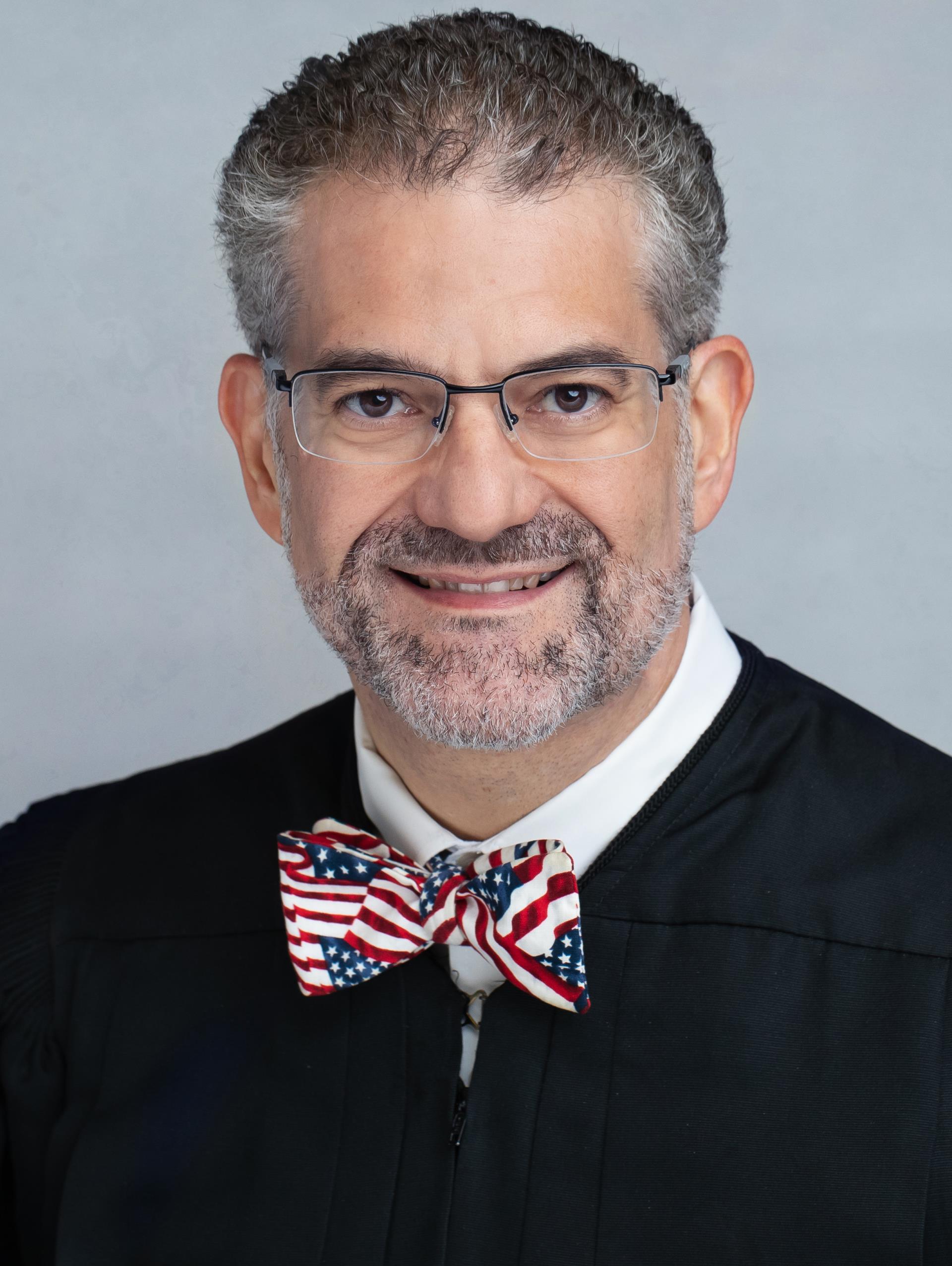 The Honorable Michael Warren was appointed to the Sixth Judicial Circuit Court in December 2002 by Governor John Engler; elected in 2004, 2006, 2012, 2018 and 2024; Presiding Judge, General Civil/Criminal Division, 2010-2013; 2015-2017
- Sponsor and initial pilot Judge, Sixth Judicial Circuit Court Data Management System project (eFiling and paperless courtroom), 2004-present
- Visiting and Adjunct Professor, Constitutional Law, Western Michigan Cooley Law School
- Co-creator, Patriot Week (patriotweek.org)
- Host, Patriot Lessons American History & Civics Podcast
- Co-producer, Patriot Lessons (Birmingham/Bloomfield Community TV)
- Author: America's Survival Guide - How to Stop America's Impending Suicide by Reclaiming Our First Principles and History (Mill City Press, 2007)
- Member, Supreme Court Committee on Model Civil Jury Instructions, 2008–2017
- Member, Executive Committee, 2022-present; Outreach Committee, 2015-present; Rules Committee, 2015; Michigan Judges Association
- Member, Oakland County Bar Association Diversity Committee, 2010-2016
- Author: Constitutional Law, Wayne Law Review, 2010, 2011 & 2018; Contempt of Court (How-to-Kit), Institute of Continuing Legal Education, 2005; Why Ignoring Contempt of Court Undermines Justice, the Rule of Law, and Republican Self-Government (Engage), 2006; and various guest commentaries in the Detroit News, Detroit Free Press, Oakland Press, and other newspapers
- Member, State Board of Education, 1999-2002; Secretary, 2001-2002
- Chair, State Board of Education Task Force on Embracing the Information Age, 2001-2002
- Member, State Board of Education Task Force on Social Studies, 2004
- Executive Director and counsel, 2001-2002, and Secretary-Treasurer, 2004-2009, for The New Common School Foundation
- Partner and Associate, Honigman Miller Schwartz & Cohn LLP, with experience in appellate work and litigation; corporations, securities and mergers; and education law, 1994-1995; 1997-2001
- Legal and policy advisor for the State Board of Education, 1995-1997
- Michigan Supreme Court Judicial Clerk for Justice Dorothy Comstock Riley, 1992-1994
- Graduate of the University of Michigan Law School (Juris Doctor Degree, Cum Laude) and Wayne State University (Bachelor of Arts Honors History, Magna Cum Laude)
- Trustee: Michigan Council on Economics Education
- Chair, Oakland County Bicentennial Study Group and Bicentennial Executive Committee, 2017-2020
- Chair and Board Member, Cornerstone Schools Association and Cornerstone Education Group, 2010-2019
- Recipient: Hall of Fame (2021), Judge of the Decade (2019) and Judge of the Year (2018), International Association of Top Professionals; Distinguished Public Servant Award, Oakland County Bar Association; Distinguished Jurist Award, Women’s Bar Association/Oakland Region; H. Wallace Parker Preserving Justice Award, Northern Oakland County Branch NAACP; the Great Influence Award, Michigan Council for the Social Studies; Special Tribute, Michigan Legislature
- Leader, Inn at Court, 2005 - 2009
- Member, Oakland County Bar Association Circuit Court Committee, 2003 - 2007
Protocol
In order to better serve the attorneys and litigants appearing in Judge Warren's courtroom, we have adopted the following protocols. Please advise your clients and staff so that there are no misunderstandings.
Oakland County Courthouse
Courtroom 5B, Fifth Floor
248-975-4250
In accordance with the underlying philosophy establishing the Business Court, the expeditious and fair resolution of business disputes is essential to a civil society and the free market. As such, proactive attention and management of the business court docket is vitally important. To ensure the same, the general umbrella philosophy applies to this docket:
- Conferences will be conducted in person, with active engagement of the Judge. They are scheduled as early as possible, with automated notices if necessary. Generally, business court disputes are best resolved amicably by the parties, the sooner the better. On the other hand, some business disputes are so intractable that full litigation is necessary. At conferences, a determination will be made whether the case is best served by adherence to a clearly defined litigation scheduling order or prompt facilitation.
- The Court expects prompt joinder and service of parties.
- Unless resolved expeditiously, each case will be subject to case evaluation or a replacement mechanism with the effect of case evaluation.
- The Court enjoys trials.
Judge Warren is the Court’s sponsor of the Electronic Data Management System (EDMS), and was the Court’s pilot e-filing and paperless courtroom judge. Now nearly all of his civil cases are required to be e-filed. If your case is an e-filing case, please become aware of, and comply with, the e-filing requirements. Please see the relevant MCR and SCAO.
Unless previously ordered to appear by the Court, the Case Management Office will issue a Notice & Order to Appear for a Case Management Conference ("CMC"). At the CMC, unless the parties agree to prompt facilitation, the Court will issue a Scheduling Order if one has not yet issued. All adjournment and extension requests must be made by motion and generally will be scheduled for hearing on motion day (oral argument is often dispensed on such motions). The Court also uses status conferences and/or pretrials. A final pre-trial order will also issue that includes additional processes and dates over and above the standard scheduling order. Motions for summary disposition are scheduled pursuant to a separate order, see infra.
Except with leave by the Court or as otherwise described herein, motions are scheduled pursuant to the local court rules and are heard on every Wednesday at 8:30am. Judge’s copies are only required on non e-filing cases. Parties must praecipe motions (other than summary disposition) and file a related Notice of Hearing for any Wednesday of their choice. The Court often dispenses with oral argument pursuant to MCR 2.119(E)(3). If oral argument is not dispensed, motions will be held via Zoom (I.D. 248-975-4250) and scheduled by the chambers staff with specific times. The docket list with assigned time-slots for each matter will be listed on Judge Warren’s online schedule the preceding Tuesday afternoon along with specific Zoom instructions and virtual courtroom protocols. Absent good cause, the Court declines to hear add-ons.
Summary Disposition Motions and hearings are scheduled pursuant to separate, independent scheduling orders issued by the Court. Although praecipes are not required when filing a summary disposition motion, the Motion Certification required by Local Sixth Judicial Circuit Court Rule 2.119(B)(2) must still be signed and filed by the attorney of record or the party in propria persona. In addition, a Notice of Hearing must also accompany the filing of a dispositive motion and it must state that the hearing date will be scheduled by a date to be determined by the Court. To ensure timeliness, parties should submit the most recent scheduling order of the Court demonstrating that no motion cut-off date has precluded the filing of the motion.
All briefs must be in the form and length set forth in the MCR; provided, however, that cases involving complex constitutional matters, class action certification, and other extraordinarily complex issues or issues of first impression may, upon the Court's approval prior to the motion deadline, have a longer page limit. If one believes there is good cause for a submission exceeding the page limitation, a Motion for Leave must be filed which can be heard during motion call before the motion deadline. Only after Court approval may a combined motion and brief beyond page limitation be submitted. In sum, a motion for leave must be filed before the Court will accept a combined motion and brief beyond the page limitations set forth in the MCR; a motion for leave must be filed before the motion deadline; and a motion for leave may not attach the proposed submission exceeding the page limitation set forth in the MCR (the combined motion and brief exceeding the page limitation may only be submitted after Court approval).
All default judgments must be scheduled for a hearing on motion day.
The Court strictly adheres to MCR 3.310 in connection with all motions to impose temporary restraining orders and preliminary injunctions.
Generally, the Court declines oral argument for motions for reconsideration and motions for resentencing.
Arraignments, pre-trial conferences, pleas, sentencing, and violations of probation are heard every Wednesday at 1:00pm. Arraignments by mail are acceptable at the request of the defendant, with a pretrial quickly thereafter. The Court will consider making sentencing representations pursuant to People v Cobbs. All pretrial motions, including motions in limine, must be heard no later than 30 days prior to trial, otherwise such motions are deemed waived.
Proposed orders must be accompanied by a verified motion & brief with supporting authority, proof of certified address, postal verification, affidavit of process server (or reason why one cannot be given) showing at least 3 attempts (service on individuals, these 3 attempts must be during times which a working individual would reasonably be expected to be at home or at the place of business attempted to be served).
Proposed orders must be accompanied by supporting authority, summons expiration date, verified motion & brief, postal verification, proof of certified address, affidavit of process server (or reason why one cannot be given) showing at least 3 attempts (service on individuals, these 3 attempts must be during times which a working individual would reasonably be expected to be at home or at a the place of business attempted to be served).
Pro hac vice admissions of counsel must be accompanied by a recommendation, a proper affidavit in which the counsel accepts jurisdiction of the Michigan Rules of Professional Conduct and enforcement thereof, and agreement that all notices to the represented party are sent to in-state counsel.
For all civil cases, a theory of the case, jury instructions and verdict form in written and electronic form (Word) (or trial briefs in the event of a bench trial) must be filed with the Court 7 days prior to trial (if not otherwise set forth in a pre-trial order). In criminal cases, jury instructions must be presented and emailed to chambers in Word format no later than the first day of trial.
The Court is open to and encourages the use of ADR techniques.
The Court will hold settlement conferences on the request of all parties, and all parties with settlement authority must attend.
All attorneys of record must stipulate to the proposed order (i.e. incoming attorney, outgoing attorney, and opposing counsel).
The Court conducts general voir dire and, under most circumstances, attorneys conduct voir dire related to the circumstances of the case. The Court permits jurors to take notes and ask questions. The Court provides the jury with written jury instructions for deliberations. The Court conducts trials full days on Monday, Tuesday, Thursday and Friday. Jury trials do not commence on Fridays as there are no juries available on that day.